





Jamini Roy was an influential Indian artist born in West Bengal in 1887. He began his artistic training at Kolkata's Government School of Art in 1903, learning the Western styles of portraiture and landscape painting popular at the time.
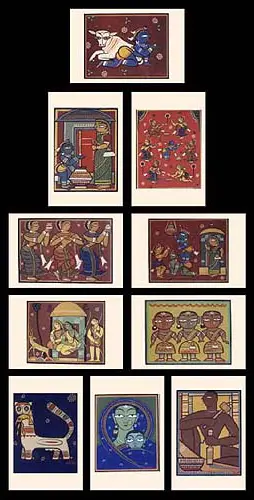
By 1925, Roy decided to shift his focus, drawing inspiration from local folk art sold near Kolkata's Kalighat temple. This led him to completely abandon Western techniques by the early 1930s. Instead of traditional canvas, he adopted local surfaces like wood, cloth, and woven mats, utilizing indigenous materials. His choice to paint on woven mats came from his admiration for the unique textures he saw in photographs of Byzantine mosaics.
A major theme in his work was the rural Santhal tribe. He uniquely blended their cultural aesthetics with bold, minimal strokes inspired by Kalighat art and Bengal temple terracotta designs. His flat, two-dimensional paintings featured simple color applications and prominent lines, often illustrating animals, Christian motifs, and traditional figures like Radha or a mother and child.
Roy's innovative embrace of folk traditions transformed the direction of modern Indian art. He was honored with the prestigious Padma Bhushan award in 1955 and passed away in 1972.