





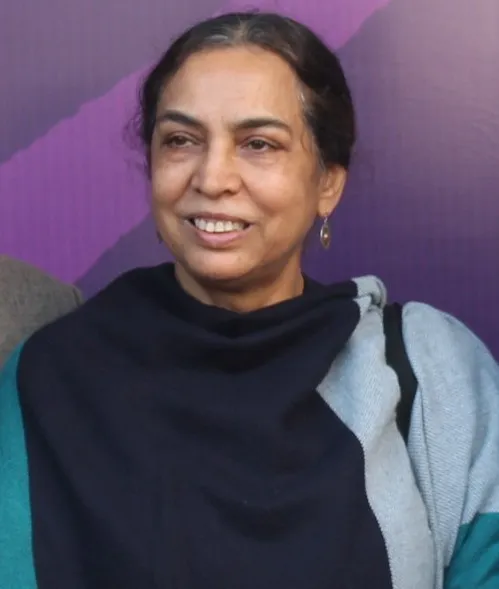
Arpana Caur is a preeminent self-taught Indian contemporary artist whose work is deeply intertwined with the social, spiritual, and political fabric of modern India. Born in 1954 in Delhi into a Sikh family, she was profoundly shaped by the cultural atmosphere of her home, which was steeped in Punjabi literature and music. Despite having no formal training in painting, she has developed a globally recognized visual language that addresses the most pressing issues of our era, including environmental decay, the cycle of life and death, and the persistence of violence.
A central figure in her oeuvre is the "woman," often depicted in urban settings or engaging in domestic tasks like sewing. However, Caur uses these everyday scenes to make powerful political statements. For instance, her recurring motif of clothing and scissors serves to both honor traditional femininity and subvert it, suggesting that women are active participants in weaving larger human destinies. Her style is a unique fusion of modern concerns and ancient traditions, drawing inspiration from Pahari miniatures as well as folk art forms like Warli and Madhubani. Notably, she was a pioneer in collaborating directly with folk artisans.
Throughout her career, Caur has responded to traumatic historical events such as the Partition, the 1984 Sikh massacre, and the bombing of Hiroshima with a sense of "melancholy and mysticism." Her prestigious commissions, including a mural for the Hiroshima Museum of Modern Art, highlight her role as a compassionate witness to human suffering. Today, her works are housed in major international museums from London to Singapore.